

How Cognitive Distortions Can Keep You Awake at Night
By Dr. Charles R. Freeman, Ph.D.
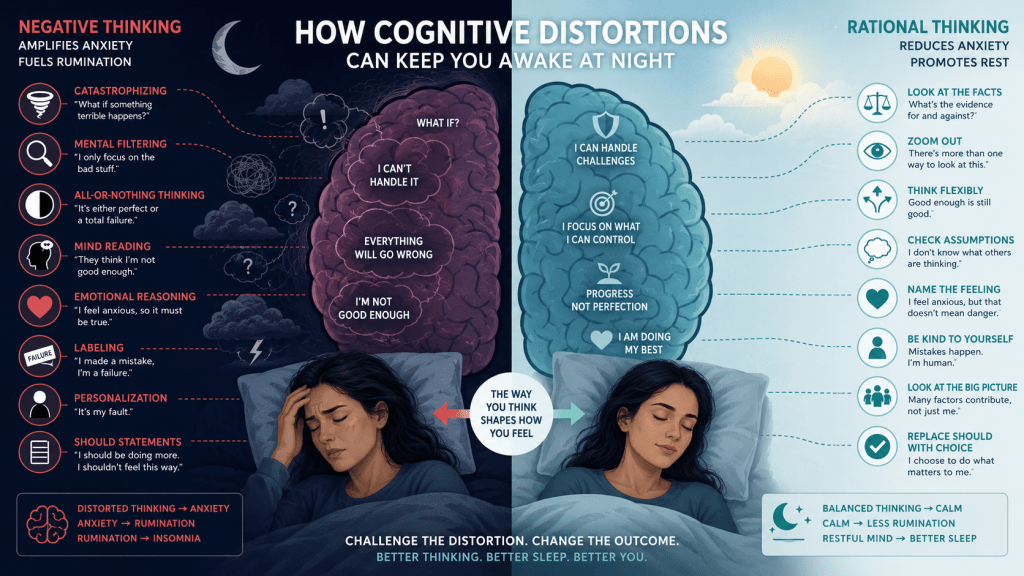
Cognitive distortions can keep you awake at night by turning normal worries into threats, mistakes into disasters, and wakefulness into panic. The body may be tired, but the mind stays active because it is interpreting thoughts as danger.
Many people with insomnia believe they have a sleep problem only. They may try sleep hygiene, supplements, medication, apps, or a stricter bedtime routine. Those steps may help some people, but they often do not reach the deeper pattern. If the mind uses the night to criticize, predict failure, review regrets, or compare life progress, sleep becomes harder to regain.
In my practice, I often see patients who wake up between 2:00 and 4:00 AM and immediately begin thinking. The thoughts may sound practical at first. Then they become harsh, repetitive, and emotionally charged. That is where cognitive distortions often enter the insomnia cycle.
What Are Cognitive Distortions?
Cognitive distortions are inaccurate or exaggerated thinking patterns that increase emotional distress. The term is often associated with cognitive therapy, including the work of psychiatrist David Burns, M.D., who helped popularize practical ways to identify distorted thinking.
A cognitive distortion is not the same as having a random negative thought. Everyone has negative thoughts. A distortion becomes clinically important when the thought feels completely true, triggers anxiety or shame, and keeps the nervous system activated.
At night, these thoughts can become especially powerful because there are fewer distractions. The room is quiet. The body is still. The mind has more space to review the past and predict the future. For someone with insomnia, that quiet can become a stage for rumination.
How Do Cognitive Distortions Keep You Awake at Night?
Cognitive distortions keep you awake by increasing arousal. When the brain believes something is wrong, dangerous, shameful, or urgent, the body prepares to respond. Heart rate may increase. Muscles may tighten. Breathing may change. The mind may become more alert.
This creates a problem for sleep. Sleep requires a reduction in effort and vigilance. Cognitive distortions do the opposite. They make the mind work harder. They tell the person to solve the problem now, prevent failure now, or review the mistake again.
For example, a patient may wake up and think, “If I do not fall back asleep, tomorrow will be ruined.” That thought may feel reasonable at 3:00 AM. But it also creates pressure. The pressure creates anxiety. The anxiety keeps the patient awake.
Which Cognitive Distortions Commonly Affect Insomnia?
Several cognitive distortions frequently show up in chronic insomnia. Patients may not use these names, but they often recognize the patterns once treatment begins.
- Catastrophizing: “If I sleep badly tonight, I will not be able to function tomorrow.”
- Mental filtering: Focusing only on failures, losses, or mistakes while ignoring evidence of strength or progress.
- Should statements: “I should be asleep by now,” “I should be more successful,” or “I should have fixed this already.”
- Labeling: “I am broken,” “I am weak,” or “I am a failure.”
- Emotional reasoning: “I feel hopeless, so things must be hopeless.”
- Overgeneralizing: “I slept badly again, so I will never sleep normally.”
These thoughts do not only affect mood. They affect the body. The brain treats them as signals that something needs attention. When the mind becomes activated, the body often follows.
Why Does Insomnia Make Cognitive Distortions Worse?
Poor sleep reduces emotional resilience. After several nights of insomnia, people often become more sensitive, more discouraged, and less flexible in their thinking. A problem that might feel manageable during the day can feel unbearable in the middle of the night.
This creates a cycle. Distorted thinking increases insomnia. Insomnia increases emotional vulnerability. Emotional vulnerability makes distorted thinking feel even more believable. The patient then enters another night expecting failure, and the bed becomes associated with worry rather than rest.
That is why chronic insomnia often needs more than reassurance. The patient needs a structured way to change the relationship between wakefulness, thoughts, emotions, and the body.
How Does CBT-I Address Cognitive Distortions and Insomnia?
CBT-I, or Cognitive Behavioral Therapy for Insomnia, treats the patterns that maintain chronic insomnia. It may include stimulus control, sleep scheduling, sleep restriction when appropriate, relaxation training, and cognitive restructuring.
Cognitive restructuring helps patients identify thoughts that intensify arousal and replace them with more accurate, flexible responses. This does not mean pretending everything is fine. It means learning to think in a way that lowers threat rather than increasing it.
For example, “I will never function tomorrow” may become, “Tomorrow may be harder if I sleep poorly, but I have handled difficult days before.” That change may look small, but the nervous system responds differently to a manageable problem than to a catastrophe.
What I Often See in Practice With Cognitive Distortions and Insomnia
I often see patients who have tried very hard to fix sleep. They read about sleep, monitor every hour, track every symptom, and judge every night. The problem is that all this effort can become part of the insomnia pattern.
Some patients wake up and begin a mental review of their entire life. They think about work, age, relationships, money, family, past decisions, and future risks. The mind moves from one topic to another, but the emotional theme stays the same: “Something is wrong, and I must fix it now.”
In treatment, we slow that process down. We identify the exact thoughts that appear during wakefulness. We look for catastrophizing, mental filtering, labeling, emotional reasoning, and “should” statements. Then we build practical responses that help the patient step out of the cycle.
Good insomnia treatment does not tell patients to stop thinking. That usually does not work. It helps patients recognize when thinking has become threat-based, repetitive, and sleep-disrupting. Then they learn what to do next.
Can Trauma Make Cognitive Distortions Worse at Night?
Yes. Trauma can make the nervous system more vigilant. A person with trauma-related sleep disturbance may have trouble feeling safe enough to sleep deeply. The mind may scan for danger, rejection, criticism, or failure even when no immediate threat exists.
In these cases, cognitive distortions may be tied to older emotional learning. A patient may not only think, “I made a mistake.” The thought may feel like danger, humiliation, abandonment, or loss of control. That emotional intensity can keep the body activated.
Treatment may need to address both insomnia and trauma-related arousal. CBT-I can help with sleep patterns, while trauma-focused work can help reduce the emotional charge that fuels nighttime vigilance.
How Can You Start Changing Nighttime Thoughts?
A useful first step is to write down the thoughts that appear when you wake up. Do not try to solve them at 3:00 AM. Record them briefly and look at them later, when your brain is clearer.
Ask yourself:
- Is this thought a fact, a fear, or a prediction?
- Am I catastrophizing?
- Am I using “should” statements?
- Am I ignoring evidence that does not fit the fear?
- What would I say to someone else who had this thought?
The goal is not to win an argument with your mind. The goal is to reduce arousal. When the thought becomes less threatening, the body has a better chance to return to sleep.
Key Takeaways
- Cognitive distortions can keep the brain alert at night.
- Catastrophizing, mental filtering, labeling, emotional reasoning, and “should” statements often worsen insomnia.
- Poor sleep can make distorted thoughts feel more believable.
- CBT-I helps patients change both sleep behaviors and sleep-disrupting thoughts.
- Patients can learn skills that reduce nighttime rumination and conditioned arousal.
FAQ
Can cognitive distortions cause insomnia?
Yes. Cognitive distortions can increase anxiety, shame, and physiological arousal at night, making it harder to fall asleep or return to sleep after waking.
Why do my thoughts feel worse at night?
Nighttime thoughts often feel worse because the brain has fewer distractions, fatigue lowers emotional resilience, and wakefulness can trigger fear about the next day.
What is catastrophizing in insomnia?
Catastrophizing means predicting the worst possible outcome. In insomnia, it may sound like, “If I do not sleep tonight, tomorrow will be completely ruined.”
Does CBT-I help with racing thoughts?
CBT-I can help by reducing conditioned arousal, improving sleep behaviors, and teaching patients how to respond differently to sleep-disrupting thoughts.
Should I try to stop thinking at night?
Trying to force thoughts away often increases pressure. It is usually more helpful to recognize the pattern, reduce threat, and use a planned response.
Conclusion
Cognitive distortions can keep you awake at night because they make the brain believe there is something urgent to solve. The thoughts may feel true, but they often increase fear, shame, and pressure at the exact time the body needs safety and calm.
Insomnia treatment works best when it addresses both sleep behavior and the mental habits that keep the nervous system activated. With CBT-I, cognitive restructuring, and practical behavioral strategies, patients can learn to respond differently to nighttime thoughts and give sleep a better chance to return.
About the Author
 Dr. Charles R. Freeman, Ph.D., is a psychologist specializing in insomnia, sleep disorders, PTSD, anxiety, trauma, and Cognitive Behavioral Therapy for Insomnia (CBT-I). He has more than 25 years of experience helping individuals improve sleep, emotional well-being, and overall quality of life through evidence-based treatment approaches. If you would like to learn more about treatment options or schedule a consultation, please contact Dr. Freeman.
The information in this article is provided for educational purposes only and is not intended to replace professional medical or psychological advice. Individual circumstances vary, and readers should consult a qualified healthcare professional regarding their specific concerns.